
Unearned Income and Deposits in HCP
Unearned Income and Deposits in HCP
It’s important to know how to properly record deposits and unearned income on your invoicing software to keep your financial records accurate, organized, and ready for tax time. In this blog, we’ll walk through how to handle these processes in Housecall Pro and ensure the information flows correctly into QuickBooks. By setting things up the right way, you can maintain clearer records and avoid common accounting mistakes.
First Method to Record Unearned Income
New Job, First Segment: Deposit
Let’s start by walking through the first method of recording the income properly and promptly in Housecall Pro. Start by creating a new job. Enter the customer’s name so HCP can populate and enter the services and/or materials for this job. Your page should look something like this photo:

You will then save this job created. Next, do not scroll down to add a deposit towards the bottom, or you will push the entire job to integrate to QBO. The objective is to split it bit by bit, and to do so, you will need to alter the quantity to change the flat rate. Next, click the wrench and gear icon at the top of the job page, then click Copy to new segment (see reference below).

Second Segment: Equipment
Following this step, you should see a new tab next to “Segment #1,” and you will rename the first tab, so the tab named “Segment #1” is renamed “Deposit”. From here, if, for example, you want to bill 50% of the total amount, enter .50 in the quantity field so it reflects half of the original amount charged.
In our first example used, we entered a service charged at $15,000. So, in this segment named “Deposit,” you will see $7,500 being charged. Here is a photo of these changes made to our example:

Next, let’s say, for the sake of our example, that we want to charge 25% of the total because we have billed for 50%. In the second segment, we will name it “Equipment” so that we may invoice this percentage of the unit price. Here is a visual on the changes we made:
 For this instance, we create a copy of the segment, just as we did before, and we have named it “Equipment”. This allows HCP to record a partial deposit for the service billed and integrate this portion of the job to QBO. You will also need to send the invoices so that your customer can receive and pay for these percentages you have entered.
Third Segment: Final
Next, you want to bill for the remaining amount, which will be the remaining 25% of the total $15,000, equaling $3,750. You will do the same to create a copy and name the third segment as “final”, then select to invoice the customer. The following photo reflects these adjustments.

Recording payment for these jobs will be fairly simple. You can select the pay icon, and HCP provides options to record payment for all segments at once or for specific segments (see the following reference).

This example shows what you will see and be able to select for payment when you select the pay icon.


Overall, this first method will allow you to tailor it to what fits best with the job and customer needs, but it works best for billing at flat rates or one-line items. It allows a smoother integration with QBO and accurate billing records for both you and your customer.
If you’re not going to be billing at flat rates and you would like to bill for time and/or materials, we recommend that you have one segment that has the total on it. This will help you reference back to compare all the following segments. This concludes the step-by-step process on the first method.
Second Method for complexities of billing time and materials
Now, we will move towards the second method.
We will start by creating a new job just as we did in the first example. Enter the customer name, what you are billing for, and the full total, then save the job. For this method, we strongly encourage you to practice and implement it. It provides a more organized process of recording, and here is why.
When you receive a deposit on a job, you have not yet earned the income. It’s not funds that should be showing on your Profit & Loss Report because you haven’t yet earned it physically. It is technically a liability because until you complete that job or until you complete certain stages of the job, based on a customer agreement created with you and your customer, you haven’t earned those funds. By using this technique, you can record the deposit as unearned income and avoid it being reflected on the P&L.
First Segment: Job # plus Segment #1 (ex. #2224-1)
Once you have created this new job, entered the agreed-upon service, and saved it, we can create a service item called “Deposit” and add it on. You should not select the “Add deposit” function toward the bottom because you will have a service item called “Deposit”; see the following reference. You will need to input the deposit amount received as a negative in this portion.
 Second Segment: Deposit
After this step, select the wrench and gear icon to add a Segment, and name it Deposit. Once created, you will need to add a service and add the deposit again. The difference is that, in this section, we will enter the deposit amount as a positive number, as shown in the next photo.

By doing these steps, you will send one invoice to the customer for the Deposit; in our example, $5,000. You will also be sending the 1st segment invoice for the service and sales tax billed; in our example, we used $20,000. Creating the negative deposit in this first segment prevents a duplicate amount from being recorded in QBO. So now our example should be showing a $15,000 amount being billed plus the sales tax.
 QBO account mapping for “Deposit” service item created:
This next step is crucial to follow and complete because it will include the proper usage and mapping of accounts in QBO. Please make sure the “Deposit” service line created is not showing as an income account in QBO. You won’t be able to alter this in HCP because you will need to configure it in QBO. From here, log in to your QuickBooks through a different tab and keep your HCP tab with the job created open because we are not done with it.
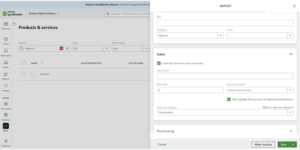
In QBO, find all apps from your menu, and select the “Sales & Get paid” window. This step can look different depending on the version of QBO you are using, but you will ultimately find the comparable tabs. After navigating to the Sales tab, you will need to find the “Products and Services” tab and select to open the page. Once on this page, search for “Deposit.”
If it is not on this page, go to your HCP page and push/integrate the first segment to QBO. When it becomes available in QBO, you can click into it to open a sidebar that details basic info, sales, and purchasing sections. In the sales portion, you will need to find “Unearned Income” under the “income account*” field. If you do not see this, you will have to create this account in your chart of accounts by selecting the “+Add new” option.
You will type in Unearned Income and create it as an “other current liability” account. After completing these steps, make sure to select the checkbox underneath this field that says, “Also update this account in historical transactions.” Select this box because it will move all previous products and services or invoices that use this account. Here is a photo reference of what you should be seeing on your page.
Now, you are through with any more actions in QBO, and you may push/integrate the “Deposit” segment to QBO. Fundamentally, by doing this method, it will not affect your P&L to increase your income by the deposit amount; instead, it will reflect on the Balance Sheet under Unearned income, the liability account.
Once you are through with creating your job in HCP and you are ready to invoice the customer, you may now select the finish icon at the top of the job page. Don’t worry about the negative deposit amount because that will negate out and reduce $5,000 on the unearned income on the balance sheet. It will record the total billed; in the example, it was $20,000, all at once.
This provides proper recording on the P&L report for when you have completed the job or stages and received the earned income.
You can also combine this technique with the first process practiced above, where you have progress invoicing. For example, you can take the $5,000 deposit and have multiple segments to bill as you go. I
In most cases, when there are larger projects or new construction projects, our clients will have different segments for the deposit stage, a different segment for the rough-in stage, a segment for equipment install, a separate segment for finalization, and lastly a different segment for the retainage. Then you have 4-5 different invoices, and we can apply the same approach of entering a negative amount on the retainage or the finalization amount to reduce the final invoice by whatever is due.
Light at the end of the tunnel
Wow! I’m glad you saw this through to reach the end of this step-by-step process. If you prefer a video of this explanation, we will have it posted on our YouTube page named “Unearned income and deposit invoices in HCP”. We will also have other videos guiding you through processes and strategies to maintain your accounting records in HCP and QBO.
At the end of this, our hope is you learned new methods to record unearned income and create deposits in HCP and QBO. We highly recommend you take the second approach, especially if you are creating a larger number of stages in the project because it allows more accuracy in your financial reports. However, keep in mind this will affect some of your reporting in HCP because of the differences in recording income between HCP and QBO.
If you have more questions or concerns about these methods or the differences in recording income in HCP and QBO, please don’t hesitate to reach us at info@waterfordbusiness.com or call us at 864-351-0852.